Two of Pentacles · Stoicism
Two of Pentacles Meets Stoicism: The Discipline of Acceptance
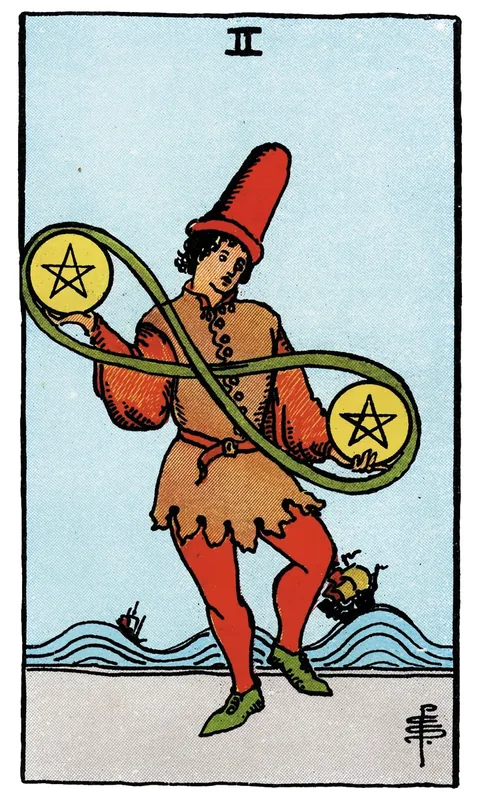
The archetype
The Two of Pentacles is about balance kept in motion: you are holding two things at once—two responsibilities, two expenses, two roles—dancing on a moving wave. Its wisdom is not to freeze for stability but to shift your weight with the swell, accept that resources are finite, and move nimbly between priorities. Change is the constant here, and you are better at this dance than you think.
The Stoicism lens
Stoicism reads the card as a test of judgment: external events are indifferent, and only your response to them carries moral weight.
At its core, Stoicism, shaped by Epictetus and Marcus Aurelius in Greco-Roman antiquity, holds that peace comes from sorting what is within your control from what is not. Placed beside Two of Pentacles, whose imagery includes two pentacles held in the hands, an infinity-shaped ribbon, rolling waves, ships rising and falling in the distance, and a dancing posture, the card stops being a prediction and becomes a mirror for how you meet your situation.
Reading Two of Pentacles upright
Two of Pentacles’s energy of balance, juggling, and flexibility finds a natural dialogue here. Upright, the card points to the inner citadel, a reminder to govern attention, assent, and desire rather than chase outcomes you cannot command. Read this way, the card rewards temperance: the upright Two of Pentacles is less an instruction than an opportunity to practice it.
Reading Two of Pentacles reversed
Reversed, the Two of Pentacles shows the juggling starting to fail: you have taken on too much, your rhythm is broken, and what matters is crowded out by what merely shouts. It urges honesty about the limits of your bandwidth—not throwing the balls faster, but setting one of them down. Re-rank your priorities and leave yourself room to breathe. Reversed, the card warns of disturbance, of staking your serenity on things that were never yours to control. In Stoicism, this is the territory of anxious overreach, a signal to slow down and look again before you act.
In love and connection
You are balancing the relationship against other duties; flexible communication helps your rhythms align. Being honest about your schedule is more attractive than quietly straining. A Stoicism reading would add: let temperance guide how you show up, rather than the outcome you are hoping to secure.
In work and direction
You are running several projects at once; lists and time-blocking help manage the rhythm. Short-term flexible scheduling buys steady output. Through this lens, progress is measured less by status and more by whether your choices express temperance.
A question to sit with
What part of this situation is genuinely up to you, and what must you release?
A practice for this week
List every ball currently in the air, rank them honestly, then deliberately set one or two down. Balance comes not from holding more, but from the courage to choose. Each morning, separate the day into ‘up to me’ and ‘not up to me’, and invest your energy only in the first column.
A note on using this reading
This content is for self-reflection and entertainment only and does not constitute medical, legal, or financial advice.
Want a live reading for your own question? Draw with The Stoic Gardener