The High Priestess · Stoicism
The High Priestess Meets Stoicism: The Discipline of Acceptance
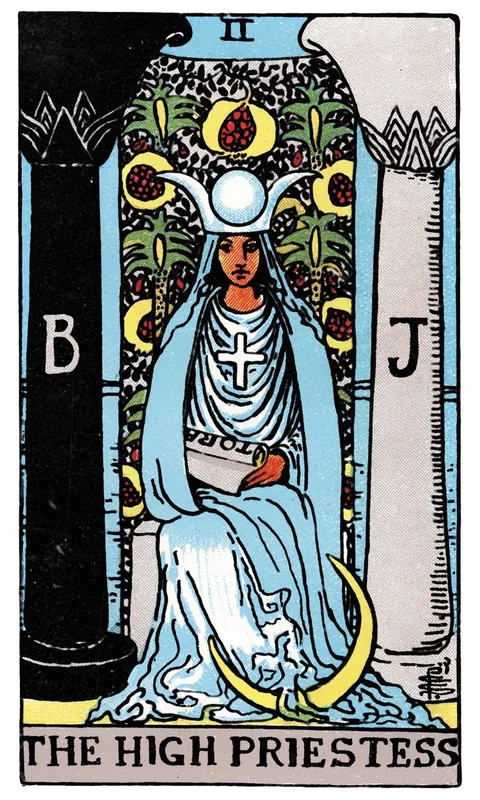
The archetype
The High Priestess represents certainty found beyond noise. You do not need to explain everything right away; listen first to the language of your body and dreams. This card suggests the answer is still forming and clarity comes through stillness. When you respect the unknown, truth tends to arrive in a more mature and reliable shape.
The Stoicism lens
Stoicism reads the card as a test of judgment: external events are indifferent, and only your response to them carries moral weight.
At its core, Stoicism, shaped by Epictetus and Marcus Aurelius in Greco-Roman antiquity, holds that peace comes from sorting what is within your control from what is not. Placed beside the High Priestess, whose imagery includes moon, veil, scroll, black and white pillars, and pomegranates, the card stops being a prediction and becomes a mirror for how you meet your situation.
Reading The High Priestess upright
The High Priestess’s energy of intuition, silence, and subconscious finds a natural dialogue here. Upright, the card points to the inner citadel, a reminder to govern attention, assent, and desire rather than chase outcomes you cannot command. Read this way, the card rewards temperance: the upright High Priestess is less an instruction than an opportunity to practice it.
Reading The High Priestess reversed
Reversed, The High Priestess can mean ignoring your intuition, or being pulled into anxiety through secrets and speculation. Stop demanding certainty from the outside and return inward. Clarify what you are truly afraid of, and which truth you have been avoiding. Reversed, the card warns of disturbance, of staking your serenity on things that were never yours to control. In Stoicism, this is the territory of anxious overreach, a signal to slow down and look again before you act.
In love and connection
Love needs more listening and space, and trust grows slowly. Pay attention to small inner discomfort; it is often more truthful than words. A Stoicism reading would add: let temperance guide how you show up, rather than the outcome you are hoping to secure.
In work and direction
Good for research, study, strategy, and behind-the-scenes progress. You do not need to be loud, but you do need to hold the information. Through this lens, progress is measured less by status and more by whether your choices express temperance.
A question to sit with
What part of this situation is genuinely up to you, and what must you release?
A practice for this week
Slow down and gather both information and feelings. Write down intuitive signals and recurring clues, and let time confirm them instead of rushing to conclusions. Each morning, separate the day into ‘up to me’ and ‘not up to me’, and invest your energy only in the first column.
A note on using this reading
This content is for self-reflection and entertainment only and does not constitute medical, legal, or financial advice.
Want a live reading for your own question? Draw with The Stoic Gardener