The Fool · Existentialism
The Fool Meets Existentialism: Embracing Radical Freedom
The archetype
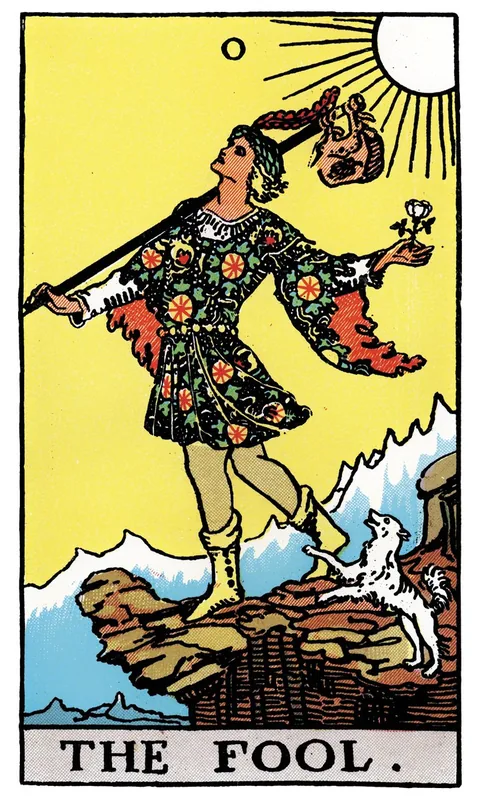
The Fool stands at the cliff’s edge with a small bundle and a white rose, looking up rather than down. He is numbered zero: not yet defined, not yet committed, still free to become almost anything. This is the moment before the story starts, when the old self has loosened its grip and the new one has no name. The card is not naïveté so much as openness — the willingness to take a step before you can prove it was the right one.
The existentialist lens
Existentialism begins where the Fool is standing: with a person who has no fixed essence handed down in advance. Jean-Paul Sartre’s claim that “existence precedes essence” means there is no blueprint of who you are supposed to be, only the choices through which you make yourself. The cliff, then, is not a threat. It is the ordinary condition of being free. Sartre would say the dizziness you feel looking over the edge is not fear of falling but anguish at realizing how much is genuinely up to you.
The white dog at the Fool’s heel is worth keeping. Freedom is not recklessness; it is choice made with your whole attention, instinct included.
Reading The Fool upright
Upright, the Fool asks you to choose in good faith. To act from your own values rather than from the script your family, your job, or your fear has been quietly running for you. The card’s energy of new beginnings, trust, and freedom is an invitation to author the next chapter deliberately — to say “this is mine” about a decision instead of letting it happen to you. Existentialism offers no guarantee that the leap pays off. It offers something better: the chance to live a life that is actually yours.
Reading The Fool reversed
Reversed, the Fool reveals the trap Sartre called bad faith — pretending you had no choice. Here freedom curdles into impulsiveness or avoidance: you leap to escape a decision rather than to make one, or you stall forever and call your paralysis “keeping options open.” Both are ways of hiding from responsibility. The reversed card is not telling you to stop moving. It is asking you to notice when “going with the flow” has become a way to avoid owning where you are headed.
In love and connection
A relationship under the Fool is light, open, and unwritten. The honest move is to let it be exactly that — to share experience and watch each other’s rhythm rather than rushing to define what it “is.” Through an existentialist lens, the question is not “where is this going?” but “am I showing up authentically, or performing a version of myself I think will be chosen?” Choose presence over performance and the connection has room to become real.
In work and direction
The Fool favors the new direction, the cross-disciplinary leap, the project you can’t yet justify on a résumé. Make learning the goal instead of instant proof. Existentialism reframes career not as a ladder you’re supposed to climb but as a series of commitments that express who you are deciding to be. Progress is measured less by the title you reach and more by whether the work is genuinely chosen.
A question to sit with
If meaning is made and not found, what will you choose to be responsible for this week?
A practice for this week
Make the first step small and specific: pick one minimal action and allow yourself to adjust while doing it — travel with curiosity, but keep a safe way back. Then take one decision you’ve been quietly outsourcing to fate or to other people, and make it consciously, owning the outcome either way. Notice how different a chosen life feels from a defaulted one.
A note on using this reading
This content is for self-reflection and entertainment only and does not constitute medical, legal, or financial advice.
Want a live reading for your own question? Draw with The Questioner of Freedom