Death · Stoicism
Death Meets Stoicism: The Discipline of Acceptance
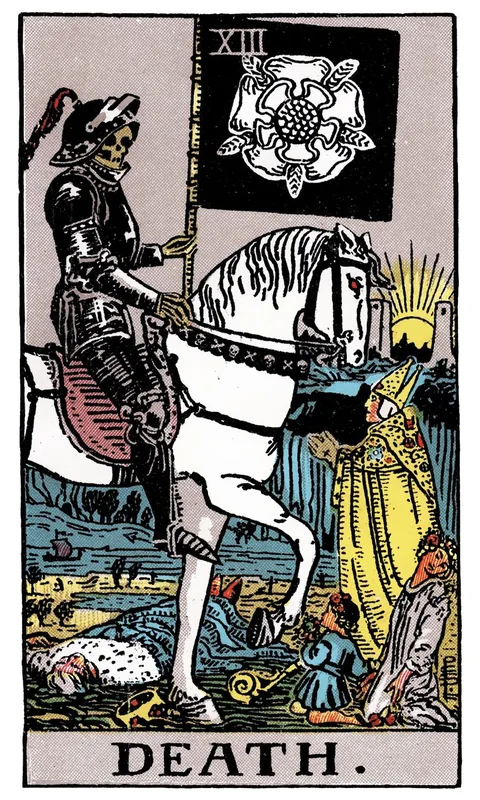
The archetype
Death represents a necessary ending. It is not a threat, but a reminder: a phase has completed, and holding on will only drain life force. This card brings clearing and renewal—shedding an old identity, relationship pattern, or habit—so new life has space to arrive.
The Stoicism lens
Stoicism reads the card as a test of judgment: external events are indifferent, and only your response to them carries moral weight.
At its core, Stoicism, shaped by Epictetus and Marcus Aurelius in Greco-Roman antiquity, holds that peace comes from sorting what is within your control from what is not. Placed beside Death, whose imagery includes skeletal rider, black flag, rising sun, river, and white rose, the card stops being a prediction and becomes a mirror for how you meet your situation.
Reading Death upright
Death’s energy of ending, transformation, and renewal finds a natural dialogue here. Upright, the card points to the inner citadel, a reminder to govern attention, assent, and desire rather than chase outcomes you cannot command. Read this way, the card rewards temperance: the upright Death is less an instruction than an opportunity to practice it.
Reading Death reversed
Reversed, Death suggests resisting what needs to end: fearing the blank space, returning again and again to what has already passed. Face the grief of letting go and remember that endings are not destruction—they are transition. The sooner you release, the sooner a new beginning can truly start. Reversed, the card warns of disturbance, of staking your serenity on things that were never yours to control. In Stoicism, this is the territory of anxious overreach, a signal to slow down and look again before you act.
In love and connection
Love reaches a turning point: either a rebirth through truth, or a respectful ending. Face change honestly and do not sustain a lifeless connection out of habit. A Stoicism reading would add: let temperance guide how you show up, rather than the outcome you are hoping to secure.
In work and direction
A career chapter ends to make space for transition. Good for structural change: restructuring teams, rebooting products, or switching direction. Through this lens, progress is measured less by status and more by whether your choices express temperance.
A question to sit with
What part of this situation is genuinely up to you, and what must you release?
A practice for this week
Name what needs to stop: a relationship dynamic, a project, a habit, or a story. Do a thorough clean-out. Keep what matters and let what is withered end. Each morning, separate the day into ‘up to me’ and ‘not up to me’, and invest your energy only in the first column.
A note on using this reading
This content is for self-reflection and entertainment only and does not constitute medical, legal, or financial advice.
Want a live reading for your own question? Draw with The Stoic Gardener